 Secure Payments


Join Our Loyalty Point Scheme & SAVE!


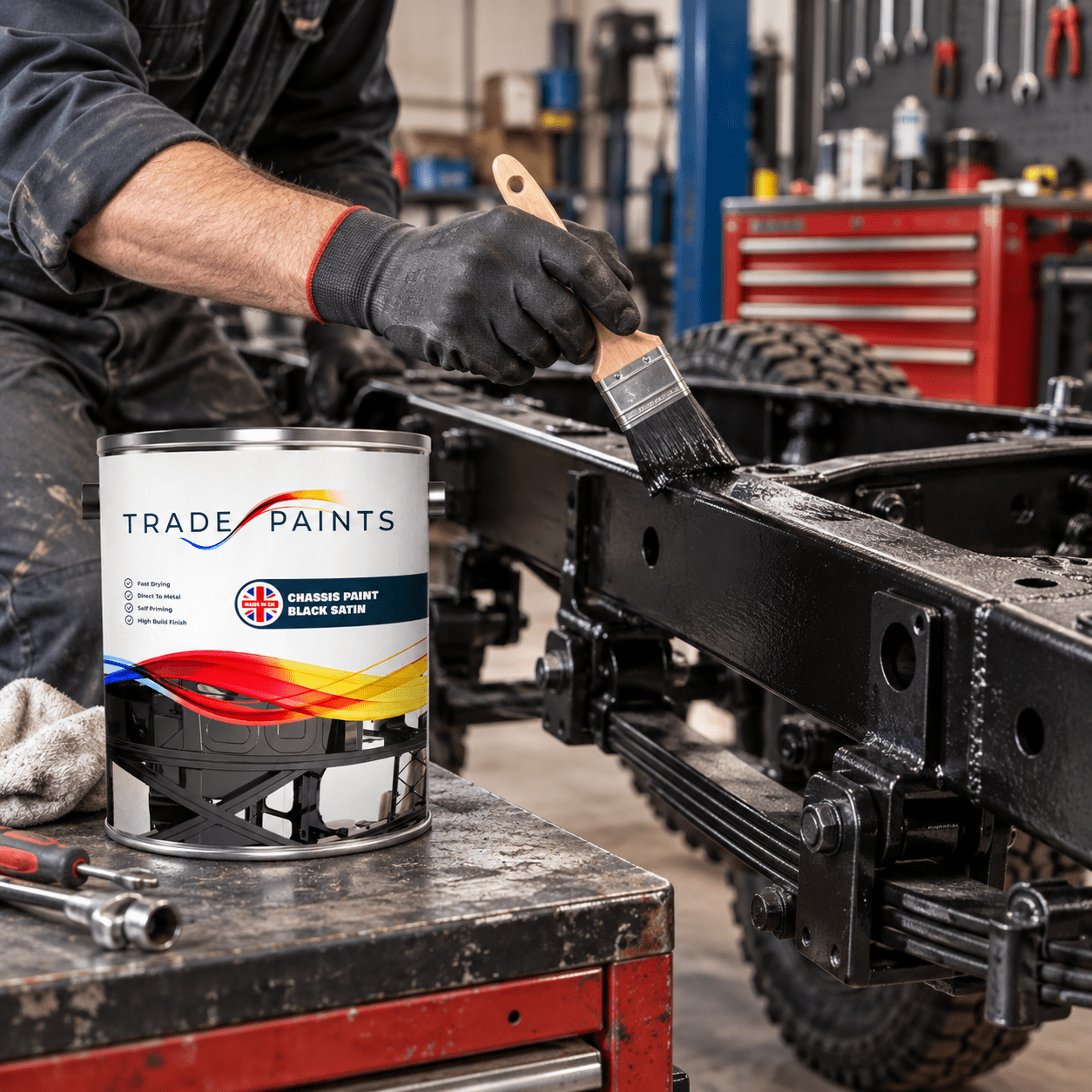
Trade Paints Chassis Paint is a high-build satin coating developed specifically for vehicle chassis and suitable industrial metalwork. It can be applied directly to properly prepared metal as both a primer and finish, helping simplify refurbishment projects.
Trade Paints Chassis Paint is particularly suitable for:
Car and commercial vehicle chassis
Classic vehicle restorations
Land Rovers and 4x4s
Vans and commercial vehicles
Trailers
Agricultural vehicles
Plant and machinery chassis
Fabricated steel frames
Suitable industrial metalwork
The coating provides resistance to oil, grease and mechanical wear, which is especially useful underneath working vehicles and equipment.
A vehicle chassis operates in one of the toughest environments on the vehicle.
It can be exposed to:
Rainwater
Mud
Road spray
Grit
Stones
Oil and grease
Surface abrasion
Winter road contamination
Small areas of exposed steel can gradually develop into more significant corrosion if they are left untreated.
September and early autumn provide a useful maintenance window while temperatures are generally more suitable for painting than during the colder winter months.
Before applying any paint, inspect the chassis thoroughly.
Look for:
Rust
Flaking existing coatings
Loose scale
Oil contamination
Grease
Mud
Damaged welds
Previous repairs
Pay particular attention to corners, brackets, crossmembers, welds and other areas where dirt and moisture tend to collect.
Paint should never be used to disguise serious structural corrosion. Where the steel has become badly weakened, the affected area needs proper repair.
Loose corrosion and flaking old coatings should be removed before painting.
Depending upon the condition of the chassis, preparation might involve:
Wire brushing
Abrasive paper
Mechanical sanding
Suitable power tools
The aim is to reach a sound, stable surface.
You do not necessarily need to remove every trace of an existing firmly adhered coating, but anything loose or poorly bonded needs to come off.
Trade Paints recommends sanding away flaking coatings and corrosion before application.
This is particularly important underneath vehicles.
Chassis surfaces frequently contain contamination from:
Engine oil
Gearbox oil
Grease
Road film
Diesel
Workshop contamination
Do not paint over it.
The surface should be clean, dry and free from oil, grease and rust contamination before coating.
Allow cleaned surfaces to dry thoroughly before continuing.
Once sanding and wire brushing are complete, remove all loose dust and debris.
Pay particular attention around bolts, welds and recessed areas.
A coating can only achieve good adhesion when it is actually in contact with the prepared substrate rather than a layer of sanding dust.
Stir the paint until it is completely uniform before application.
If you are working on a larger vehicle or trailer, stir periodically during the job.
This helps maintain consistent pigmentation and application throughout the project.
Trade Paints Chassis Paint can be applied by brush, roller or spray equipment.
Particularly useful around:
Brackets
Welds
Suspension mounting areas
Corners
Chassis rails
Detailed components
Can be useful across larger accessible steel sections.
Often the quickest option for professional restorers and workshops where suitable equipment and ventilation are available.
Whichever method you use, apply controlled, even coats.
One of the main advantages of Trade Paints Chassis Paint is that it can be applied directly to suitably prepared metalwork as both primer and topcoat.
That eliminates the need for a conventional separate primer in normal suitable applications and makes the coating particularly convenient for restorations and maintenance work.
Correct preparation is still essential.
Direct-to-metal does not mean direct-to-loose-rust, grease or dirt.
Avoid applying excessively heavy layers.
Controlled coats give better control and help reduce:
Runs
Sagging
Uneven drying
Excessive film build
Make sure edges, welds and difficult sections receive complete coverage, as these are often the areas most vulnerable to corrosion.
Trade Paints Chassis Paint is designed to dry quickly.
Under suitable conditions, the current specification gives approximately:
Touch Dry: 30 minutes
Overcoating: 1 hour
Full Cure: approximately 24 hours before heavy handling or exposure.
Actual drying will depend upon temperature, ventilation and the thickness of the applied coating.
Do not confuse touch dry with fully cured.
The current theoretical coverage is approximately 8m² per litre.
Actual consumption depends on the profile and condition of the chassis, application method and normal coating losses.
Heavily prepared or textured steel is likely to use more paint than a smooth metal panel.
No.
Black remains the traditional and most popular chassis colour, but Trade Paints Chassis Paint is also available in bespoke colours from ranges including:
RAL
BS381C
BS4800.
This can be useful for restoration projects, agricultural equipment, commercial fleets or customers wanting the chassis to coordinate with a particular vehicle colour.
The standard finish is satin, giving a practical professional appearance without an excessively glossy finish.
Older Land Rovers are particularly suitable candidates for chassis maintenance.
Their chassis and underbody components can experience decades of exposure to moisture, mud and off-road conditions.
When restoring a Land Rover:
Inspect → remove corrosion → degrease → prepare → coat → allow to cure.
Pay special attention to crossmembers, outriggers and areas where dirt and moisture accumulate.
Again, paint should only be applied to structurally sound steel.
Yes.
Trailer chassis and steel frames are ideal applications for a durable chassis coating.
This includes suitable:
Car trailers
Plant trailers
Utility trailers
Agricultural trailers
Commercial trailers
They frequently sit outdoors for long periods, making periodic inspection and maintenance particularly worthwhile.
Painting over grease
Clean and degrease thoroughly first.
Leaving loose rust underneath
Remove flaky corrosion before coating.
Painting damp steel
The substrate needs to be dry.
Ignoring hidden sections
Check corners, brackets and rear-facing chassis surfaces.
Applying coats too heavily
Controlled coats normally give a better result.
Using the vehicle immediately afterwards
Allow adequate time for the coating to cure before heavy exposure.
Chassis corrosion is much easier to deal with while it is still a maintenance job.
Leaving exposed or damaged metal throughout another wet winter can turn relatively minor deterioration into a much larger restoration project.
If the chassis remains sound, the process is straightforward:
Clean it.
Remove loose rust.
Degrease thoroughly.
Prepare the steel.
Apply Trade Paints Chassis Paint.
Allow it to cure properly.
Trade Paints Chassis Paint provides a high-build, direct-to-metal satin coating with resistance to oil, grease and mechanical wear, making it a practical choice for vehicle restoration, trailers, commercial vehicles and general chassis maintenance.
Protect it now — before autumn and winter put the chassis to the test.